The Art of Arriving
The Mercedes-Benz SL and the enduring appeal of elegance without urgency.
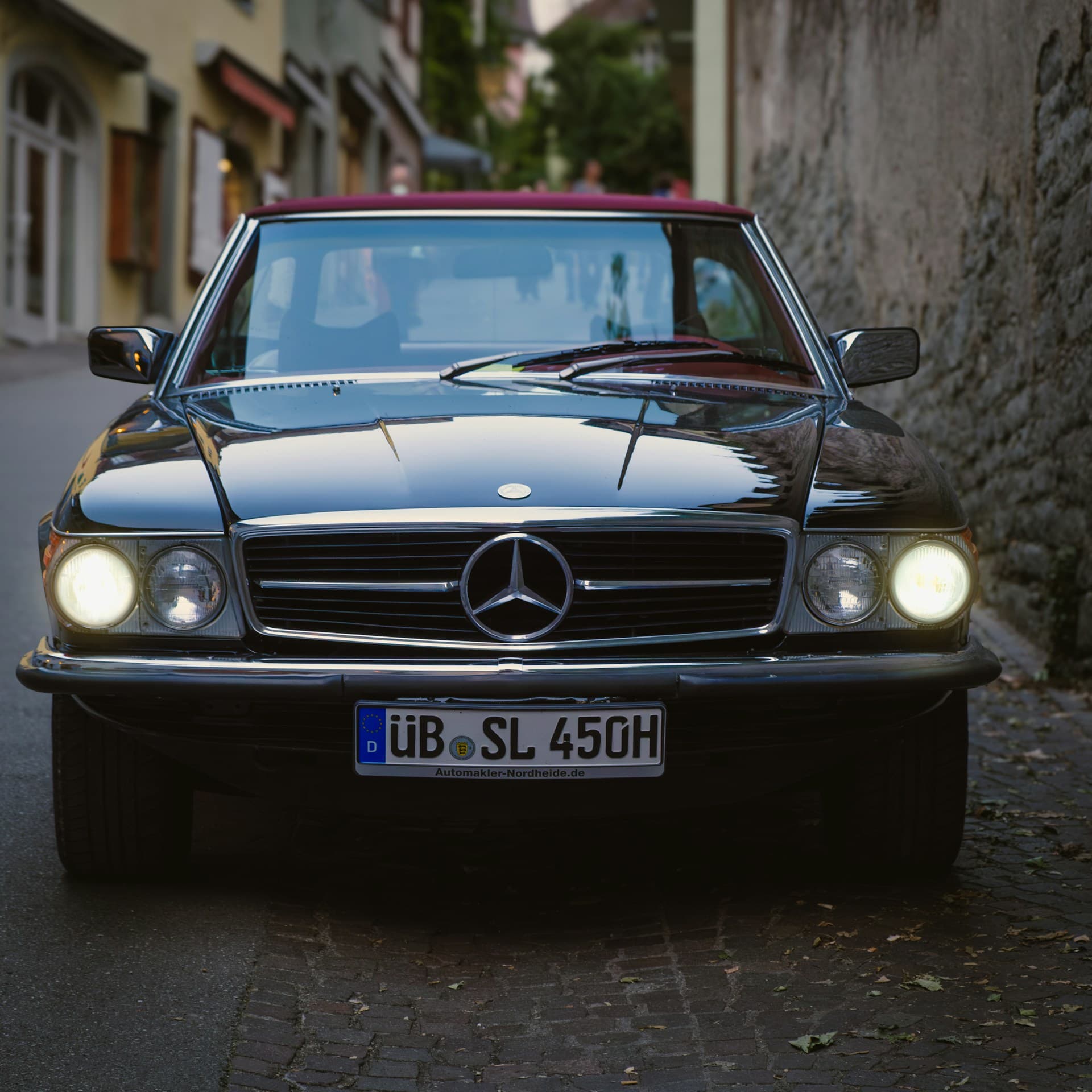
Not every beautiful car needs to look as though it is about to win a race.
Some are designed for a different kind of journey: an open road, a long afternoon and the simple pleasure of arriving somewhere without appearing to have hurried.
Few automotive names express that idea more convincingly than the Mercedes-Benz SL.
Across its many generations, the SL has occupied an intriguing space between sporting ambition and cultivated comfort. It is a car whose history begins in competition but whose cultural identity became inseparable from the art of travelling well.
From Competition to Elegance
The SL story begins with the extraordinary 300 SL of the 1950s.
Derived from Mercedes-Benz's racing achievements, the production 300 SL Coupé introduced in 1954 combined advanced engineering with one of the most memorable silhouettes in automotive history. Its upward-opening doors, necessary because of the car's structural design, became its defining feature.
The 300 SL Roadster followed in 1957, offering open-air motoring with a character of its own.
But the SL's lasting importance extends beyond these celebrated early cars.
Later generations, particularly the W113 'Pagoda' and R107, developed a different interpretation of sporting luxury. They were elegant, usable and increasingly associated with affluent leisure rather than the demands of the racetrack.
The Pagoda's distinctive removable hardtop gave it an architectural identity. The R107, produced from 1971 until 1989, became a familiar presence in the visual culture of international wealth.
These cars were not merely transportation. They suggested a particular rhythm of life.

Luxury as Composure
The most convincing luxury objects rarely need to demonstrate their value at every opportunity.
A classic SL expresses its character through proportions, materials and the quality of its engineering.
Its long bonnet and balanced stance communicate confidence without requiring aggression. The interior is designed around the pleasure of occupying the car rather than simply surviving its performance.
That distinction helps explain why the SL appeals to people who may have little interest in outright speed.
There is something inherently civilised about a machine that treats the journey as an experience rather than a problem to be completed.
Yet the SL should not be romanticised without qualification.
Earlier examples were expensive when new, and keeping them in excellent condition remains expensive today. Parts availability, corrosion, mechanical complexity and the quality of previous restoration work all influence the ownership experience.
A beautifully photographed classic roadster may conceal a considerable maintenance obligation.
The elegance is real. So are the invoices.

The Problem With Nostalgia
Classic cars benefit from an unusual advantage: they can be judged at a distance from the expectations of contemporary technology.
Nobody reasonably expects a 1960s Mercedes to offer modern connectivity or the crash protection of a new vehicle. Instead, attention shifts to its materials, proportions and mechanical character.
But nostalgia can become a poor substitute for judgement.
Not every older Mercedes was flawlessly made. Not every restoration preserves the qualities that made the original special. And a car's desirability may owe as much to its cultural associations as to its actual engineering.
The best examples deserve admiration because of what they genuinely offer, not because their age places them beyond criticism.
A Different Definition of Progress
Modern performance cars have become extraordinarily capable. They accelerate with astonishing force, negotiate corners with remarkable precision and surround their occupants with sophisticated technology.
Yet increasing capability does not always increase emotional appeal.
A classic SL offers a reminder that driving pleasure can exist at a more measured pace.
Its attraction lies partly in what it does not demand.
You need not exploit its full performance to understand its purpose. A quiet road, a well-made interior and a destination worth visiting may be enough.
The Mercedes-Benz SL has changed substantially since the 1950s, and no single generation represents its entire character.
But the most memorable examples share a philosophy: the journey should be approached with confidence, comfort and a certain sense of occasion.
There are faster ways to travel.
There may be few more elegant ways to arrive.