The VILCERIQUE Journal / Essay No. 006
The Bag That Became
More Powerful
Than Its Owner
How a practical handbag became a global symbol of privilege, desire, and the extraordinary business of wanting what we cannot easily have.
By VILCERIQUE Editorial
October 26, 2026·Brands / Fashion / Icons
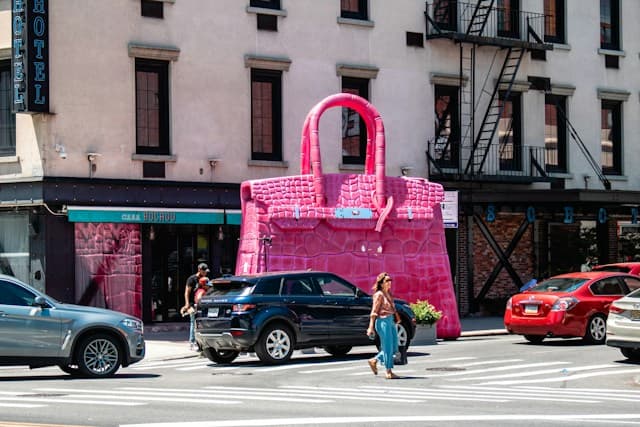
There is something wonderfully ironic about the most famous handbag in the world.
It bears the name of a woman who was never particularly interested in behaving like a luxury advertisement.
Jane Birkin was an actress, singer, and unmistakable cultural figure. British by birth and deeply associated with France, she became known for a kind of effortless style that seemed to resist the very idea of trying too hard.
She carried baskets. She wore jeans. She could make a simple white shirt appear more interesting than an entire fashion collection.
And then, almost by accident, she helped create a handbag that would become one of the most recognisable objects in luxury.
The Hermès Birkin.
Today, the bag can command extraordinary prices. Certain rare examples have sold for sums that would buy a substantial home. Its name appears in popular music, celebrity culture, fashion magazines and conversations about wealth.
But its origin was not an elaborate marketing campaign.
It was a complaint about luggage.
An Encounter Above the Clouds
The story begins in 1984, aboard an aircraft.
Jane Birkin was seated near Jean-Louis Dumas, then chairman of Hermès. As the widely told account goes, the contents of her bag spilled out, prompting a conversation about the difficulty of finding a handbag that was both elegant and practical.
Birkin needed something spacious enough for everyday life.
Dumas, whose family business had spent generations making leather goods, understood the problem.
The encounter inspired the design of a new bag, drawing on Hermès' established leatherworking traditions and its earlier Haut à Courroies design.
The result was roomy, structured and recognisably Hermès.
It had handles, straps, a flap and the kind of carefully considered construction associated with the house.
Most importantly, it was intended to be used.
That is easy to forget today.
The Birkin was not conceived as an untouchable object destined to sit behind glass.
It was supposed to carry someone's belongings.
And yet, over the following decades, it would become a symbol of something far more complicated.
When a Handbag Becomes a Passport
At some point, the Birkin ceased to be merely a handbag.
It became a signal.
To carry one was not simply to demonstrate an appreciation for leatherwork or design. It could also suggest wealth, access and familiarity with a particular social world.
A handbag had become a kind of passport.
Not a passport to another country, but to an imagined society of people who could acquire things that others could not.
This is one of luxury's most powerful mechanisms.
An expensive object communicates that its owner has money.
A difficult-to-obtain object can communicate something else.
It suggests that its owner has access.
The distinction is subtle but important.
Anyone with sufficient money may be able to buy an expensive product from a retailer willing to sell it.
But when a product is difficult to obtain through ordinary retail channels, the experience of acquiring it can become part of the product's appeal.
The story is no longer simply, I could afford this.
It becomes, I was able to get this.
And sometimes, that second message is even more desirable than the first.

The Remarkable Economics of Desire
Economists have long recognised that some goods behave differently from ordinary products.
For most things, a higher price tends to discourage demand.
Luxury can complicate that relationship.
In certain circumstances, a high price contributes to an object's appeal because it signals exclusivity, status or prestige.
Economists sometimes discuss this phenomenon in connection with Veblen goods, named after Thorstein Veblen, whose work examined conspicuous consumption and the social meaning of wealth.
But price is only one part of the Birkin's story.
Scarcity matters too.
Hermès does not publicly disclose a complete, continuously updated account of Birkin production or a universal formula for how every customer can obtain one. Availability varies by model, location and circumstances.
The mystique surrounding access has nevertheless become part of the bag's cultural identity.
That mystique has consequences.
A person who might otherwise hesitate to spend a substantial amount on a handbag may become more interested precisely because the object appears difficult to obtain.
Desire can grow in the presence of an obstacle.
We see versions of this behaviour everywhere.
A restaurant becomes more intriguing when reservations are almost impossible to secure.
A limited-edition watch attracts attention because relatively few people can buy it.
A painting becomes more desirable when collectors begin competing for it.
Scarcity does not automatically create quality.
But it can create excitement.
And excitement, skilfully sustained, can become extraordinarily valuable.
The Strange Difference Between Value and Price
Consider two handbags.
Both are made from beautiful leather. Both are carefully constructed. Both are functional, elegant and capable of lasting for many years with proper care.
One costs a few thousand euros.
The other may cost several times as much.
Is the second bag necessarily several times better?
Not in any simple, measurable sense.
Leather quality, stitching, finishing, durability and repairability all matter. Exceptional craftsmanship has genuine value, and Hermès has a longstanding reputation for specialised leatherwork.
But a luxury price is not merely an invoice for materials and labour.
It also reflects design, brand history, demand, distribution, prestige and the emotional value customers attach to ownership.
The Birkin is especially interesting because its commercial value has become inseparable from its cultural meaning.
It is not simply a beautifully made handbag.
It is a beautifully made handbag that millions of people recognise.
Recognition changes everything.
A discreet, technically excellent leather bag from a little-known maker may offer extraordinary craftsmanship.
But it cannot necessarily offer the social recognition associated with a Birkin.
And that raises an uncomfortable question.
When someone buys an object like this, how much are they paying for what it is?
And how much are they paying for what other people believe it means?
Jane Birkin Versus the Birkin
There is another irony in this story.
The woman whose name made the bag famous was not necessarily its most reverent custodian.
Jane Birkin became known for using her bags as practical belongings rather than precious museum pieces. She personalised them, attached objects to them and allowed them to show the marks of everyday life.
Her attitude reflected a style that was difficult to manufacture.
She did not seem particularly concerned with keeping everything immaculate.
And that may be precisely why her image was so compelling.
The modern luxury industry often presents perfection as an ideal.
Perfect leather. Perfect stitching. Perfect presentation. Perfect ownership.
Birkin's approach was rather different.
A bag existed to accompany a life.
If that life left marks, so be it.
In 2015, she publicly asked Hermès to remove her name from a crocodile-skin version of the bag after animal-welfare concerns were raised. Following discussions and assurances from the company, the dispute was resolved.
The episode demonstrated something important.
The woman and the product were not the same thing.
Jane Birkin had her own values, opinions and concerns.
The bag had become a commercial and cultural phenomenon with a life of its own.
By then, the object named after her was no longer entirely hers to define.
When the Object Outlives the Person
Jane Birkin died in 2023.
The handbag continues.
In one sense, this is unsurprising. Many famous products outlive the people who inspired them.
But the Birkin offers a particularly striking example of how a person's name can become detached from the complexity of their life.
Jane Birkin was an artist, a mother, a performer and a person with an identity far larger than any accessory.
Yet for many people, particularly those born long after her rise to fame, her surname may first evoke a handbag.
A luxury product has become one of the most visible parts of her cultural legacy.
There is something both remarkable and faintly melancholy about that.
The woman who helped inspire a practical bag became associated with an object that would eventually represent extraordinary wealth and exclusivity.
An object designed to make daily life easier became something people might spend years hoping to acquire.
And a name belonging to a human being became one of the most powerful names in fashion.
The Auction That Changed the Conversation
In July 2025, the original Birkin bag made for Jane Birkin was sold at Sotheby's in Paris for €8.6 million, including fees.
The extraordinary price attracted international attention.
But the significance of the sale was not merely financial.
This was not an immaculate, untouched example preserved in its original packaging.
It was a bag with a history.
A bag connected directly to the woman who inspired the design.
Its marks and modifications were part of what made it exceptional.
The sale revealed a distinction that luxury marketing sometimes struggles to explain.
An ordinary Birkin may be valuable because of its craftsmanship, scarcity and desirability.
Jane Birkin's original bag was valuable for another reason.
It was irreplaceable.
No manufacturer could simply make another one.
Its importance came from what had happened to it, who had owned it and the story it carried.
The ultimate Birkin was not the most perfect.
It was the one that had actually been lived with.
The Bag and the Person
It is tempting to dismiss the Birkin as an absurd symbol of excess.
And certainly, the culture surrounding it can appear excessive.
But that would overlook the craftsmanship, design history and genuine pleasure that beautiful objects can provide.
There is nothing inherently foolish about loving a handbag.
Nor is there anything inherently admirable about owning one.
The interesting question is what happens when an object becomes a measure of personal worth.
A handbag cannot make its owner more interesting.
It cannot guarantee taste, kindness, intelligence or happiness.
It can, however, be beautiful.
It can be useful.
It can carry memories.
And in the hands of someone who genuinely enjoys it, it can become part of a life rather than a performance of one.
Perhaps that was closer to what Jane Birkin understood than the culture that grew around her famous bag.
She did not need the handbag to become Jane Birkin.
The handbag needed Jane Birkin to become the Birkin.
The VILCERIQUE Point of View
The most extraordinary thing about the Birkin is not that people will pay so much to own one.
It is that the woman who inspired it seemed to understand something many of its admirers are still searching for.
Style belongs to the person.
Never the possession.
Sources & Further Reading
This essay combines historical reporting, auction records and economic ideas with VILCERIQUE's independent editorial interpretation of luxury culture.
- Hermès — The Birkin Bag ↗
The house's account of the Birkin's creation, design and leatherworking heritage.
- Sotheby's ↗
Auction information and provenance relating to Jane Birkin's original handbag and its July 2025 sale.
- Reuters ↗
Reporting on Jane Birkin's concerns about crocodile-skin handbags in 2015 and the subsequent resolution.
- Thorstein Veblen — The Theory of the Leisure Class ↗
The 1899 work examining conspicuous consumption and the social meaning of wealth.