The VILCERIQUE Journal / Essay No. 007
The Woman Who
Freed Fashion
— and Complicated
Her Own Legend
Gabrielle Chanel changed the way women dressed. But behind the little black dress, the pearls and the carefully constructed mythology was a life far less elegant than the clothes.
October 26, 2026·Icons / Fashion / Heritage
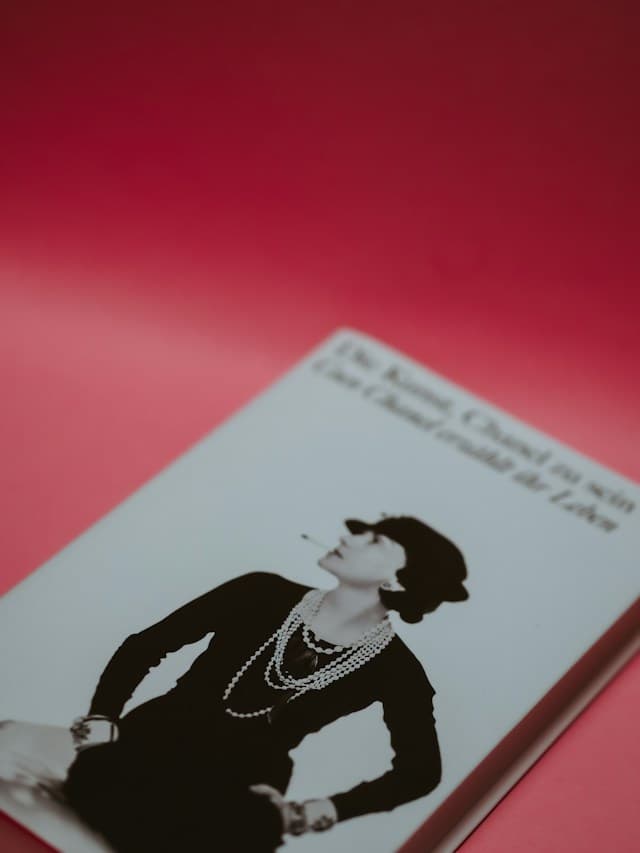
There is a particular kind of genius involved in making something look effortless.
A simple black dress. A cardigan-like jacket. A string of pearls worn without ceremony.
Today, these things seem so familiar that it is difficult to imagine a time when they represented a departure from convention.
But fashion has a peculiar habit of forgetting its own revolutions.
What once seemed daring eventually becomes respectable. What once challenged society becomes something society wears to dinner.
Few people understood this transformation better than Gabrielle Bonheur Chanel.
She was born in 1883, far from the world of privilege that would eventually become inseparable from her name.
Her mother died when she was young. Her father placed her in an orphanage at Aubazine, where she grew up under the care of religious sisters.
It was not the childhood one might expect from a woman whose name would come to represent Parisian elegance.
Perhaps that is precisely why her story is so compelling.
Chanel did not inherit the world she would later inhabit.
She constructed a place for herself within it.
And then she constructed a legend about how she had arrived.
The difficulty, for anyone attempting to understand her today, is separating the woman from the mythology she helped create.
Because Coco Chanel was not merely a designer.
She was one of her own most successful inventions.
The Freedom of Being Able to Move
To appreciate Chanel's importance, we must first understand the clothes that came before her.
Women's fashion in the late nineteenth and early twentieth centuries could be elaborate, restrictive and highly dependent on social position.
Corsetry, structured garments, substantial hats and intricate dressing conventions shaped how women presented themselves.
Of course, fashion was already changing before Chanel appeared. Designers such as Paul Poiret had challenged the dominance of the corset, and broader social changes were transforming women's lives.
Chanel did not single-handedly liberate women from restrictive clothing.
History is rarely that convenient.
But she became one of the most influential figures in translating a changing idea of femininity into a recognisable modern wardrobe.
Her designs embraced simpler lines, practical fabrics and clothes that allowed greater freedom of movement.
Jersey, previously associated largely with utilitarian clothing and undergarments, became an important part of her early work.
The result was not necessarily inexpensive clothing.
It was a different understanding of elegance.
A woman could appear sophisticated without looking as though she had spent the entire morning being assembled.
She could move.
She could work.
She could live.
And perhaps most importantly, she could dress without making the elaborate display of wealth her primary purpose.
There was an irony here, of course.
Chanel was creating expensive fashion for privileged women.
But the aesthetic she popularised challenged the idea that luxury had to announce itself through complication.
Sometimes the most radical thing a designer can do is remove something.
The Little Black Dress and the Power of Simplicity
In 1926, American Vogue published an illustration of a simple black Chanel dress.
The magazine famously compared its potential universality to the Ford automobile.
The comparison was extraordinary.
A fashionable dress was being discussed not merely as an exclusive creation, but as a design that might become a widely recognised standard.
Black clothing was not new. Nor had Chanel invented the black dress.
But she helped change its cultural associations.
Black could be modern rather than mournful.
Understated rather than severe.
Elegant without requiring elaborate decoration.
The little black dress became one of the most enduring ideas in twentieth-century fashion.
And its influence reveals something fundamental about design.
Originality does not always require inventing an entirely new object.
Sometimes it involves recognising a possibility that others have overlooked.
Chanel took familiar materials, colours and garments and gave them a new social meaning.
That is a different kind of creativity from simply making something spectacular.
Spectacle demands attention.
Simplicity has to earn it.
And when simplicity succeeds, it can survive long after spectacle has gone out of fashion.
A Woman Who Understood the Power of a Name
Chanel's achievements were not limited to clothing.
She understood that a fashion house could become something larger than the garments it produced.
It could become an identity.
A world.
A promise about the person who entered it.
The launch of Chanel No. 5 in 1921 helped establish a perfume that would eventually become one of the most recognisable fragrances in the world.
The scent was developed with perfumer Ernest Beaux, and its presentation was strikingly restrained compared with the elaborate perfume bottles of the period.
The name itself was almost defiantly simple.
A number.
Five.
Not a romantic fantasy or a poetic description.
Just a name that was easy to remember.
Over time, Chanel's visual language became equally distinctive.
The restrained colour palette. The quilted handbag. The chain strap. The contrasting trim of a jacket. The combination of costume jewellery and expensive clothing.
Not every element originated with Chanel, and several became prominent at different stages of the house's history.
But together they formed an unusually coherent identity.
This was one of her great commercial insights.
A successful design might sell for a season.
A successful visual language could survive for generations.
And a successful mythology could make people feel they were buying a small part of the person who created it.
The Chanel name became more than a signature.
It became a form of cultural shorthand.
The People Behind the Legend
The story of Chanel as an independent woman who built an empire through talent and determination contains a great deal of truth.
But it is incomplete.
Her early career was supported by relationships with wealthy and influential men, including Étienne Balsan and Arthur “Boy” Capel.
Their financial and social support helped her establish herself in circles that would otherwise have been difficult to enter.
Recognising this does not diminish her creative achievements.
It makes them more understandable.
Talent matters.
So do money, connections, timing and opportunity.
Chanel possessed remarkable instincts, but she did not build her career in isolation.
Nor was her business history free of conflict.
Her relationship with the Wertheimer family, whose business interests were central to the development and commercial success of Chanel No. 5, became a source of prolonged tension.
The division of ownership, profits and control was far less elegant than the perfume's presentation.
The lesson is not that Chanel was uniquely ruthless.
The fashion industry has never been a sanctuary from commercial ambition.
It is that the romantic story of a solitary genius often conceals a complicated network of financiers, collaborators, employees and business partners.
We like our icons to be self-made.
Reality tends to involve other people.
The Shadow of the Occupation
Then there is the part of Chanel's life that cannot be explained away as ordinary business ambition.
During the German occupation of France in the Second World War, Chanel lived at the Ritz in Paris, where German officers were also accommodated.
She had a relationship with Hans Günther von Dincklage, a German man associated with Nazi intelligence.
Historical research, including work drawing on intelligence records, has connected Chanel to German intelligence activities during the war.
The extent of her involvement, her motivations and the interpretation of particular operations have been subjects of historical investigation and debate.
But the central issue is not merely whether every allegation can be reconstructed beyond dispute.
Her wartime associations raise serious moral questions.
Chanel also attempted to use anti-Jewish legislation introduced under the occupation to challenge the Wertheimer family's control of the perfume business.
That episode is particularly difficult to reconcile with the modern image of Chanel as an uncomplicated symbol of freedom.
The Wertheimers were Jewish.
Their business arrangements had been structured before the occupation in ways that frustrated Chanel's attempt.
The episode exposes an uncomfortable reality.
A person can challenge one form of social convention while participating in, or attempting to benefit from, another form of injustice.
Creative independence does not automatically imply moral courage.
And elegance is not evidence of character.
For decades, the darker parts of Chanel's wartime history received far less attention than her fashion achievements.
The mythology proved more marketable than the complications.
But history has a way of returning to the details that publicity prefers to leave out.
Can We Admire the Work Without Admiring the Person?
This is where Chanel's story becomes larger than fashion.
What should we do with the achievements of people whose lives contain serious moral failures?
Should we stop admiring their work?
Should we separate the work from the person?
Or should we learn to hold two uncomfortable truths at once?
Chanel helped transform modern fashion.
Her wartime conduct and associations deserve scrutiny and criticism.
Neither statement makes the other disappear.
There is a temptation to approach history as a courtroom in which every person must receive a single, final verdict.
Hero.
Villain.
Worthy.
Unworthy.
But historical understanding often demands something more difficult than choosing a category.
It demands precision.
We can recognise the influence of Chanel's designs without excusing her actions.
We can examine the cultural importance of her work without pretending she was the only person responsible for changing women's clothing.
And we can acknowledge the suffering and injustice of the period without reducing the entire history of twentieth-century fashion to one designer's biography.
The question is not whether beauty can exist alongside ugliness.
History has answered that many times.
The question is whether we are willing to see both.
The House That Survived Its Founder
Chanel died in 1971.
By then, the world had changed dramatically from the one in which she had opened her first shops.
Women's lives, fashion, popular culture and the meaning of luxury had all evolved.
Yet the house bearing her name continued.
In 1983, Karl Lagerfeld became artistic director of Chanel's fashion collections and began a new chapter in its history.
His approach was not to preserve every element of Chanel's aesthetic as though it belonged in a museum.
Instead, he repeatedly reinterpreted the symbols.
The tweed jacket.
The pearls.
The camellia.
The interlocking Cs.
The handbag.
He demonstrated that a brand could remain recognisable while continually changing its appearance.
This is a delicate balance.
Too much change, and a house loses its identity.
Too little, and it risks becoming an exercise in nostalgia.
Chanel's continued prominence reveals how powerful its design language had become.
The founder was gone.
The world had moved on.
But the symbols remained intelligible.
A century after the emergence of Chanel's modern aesthetic, a simple jacket with contrasting trim can still evoke the house without requiring an explanation.
That is an extraordinary achievement in design.
It is also evidence of how successfully a person's identity can become institutionalised.
The woman disappears.
The name remains.
The Trouble With Icons
We are attracted to icons because they make complicated things appear simple.
An icon becomes a symbol of elegance, courage, creativity, rebellion or success.
The details that do not fit are gradually pushed aside.
Photographs are selected.
Stories are repeated.
Contradictions are softened.
Eventually, the public image begins to seem more real than the person.
Coco Chanel was particularly skilled at this process.
She understood presentation.
She understood the power of restraint.
And she understood that the most compelling identity is often one that appears entirely natural, even when it has been carefully constructed.
Perhaps that is why her story still fascinates.
It contains an unusual combination of genuine creative brilliance and deliberate self-mythologising.
She helped women dress differently.
She built a business of extraordinary influence.
She cultivated an image of independence.
And she left behind a wartime record that complicates any attempt to turn her life into a simple inspirational story.
The temptation is to choose the version of Chanel we prefer.
The elegant revolutionary.
Or the morally compromised opportunist.
But perhaps the more useful approach is to resist choosing.
Not because every action deserves equal weight.
And certainly not because moral wrongdoing becomes irrelevant when someone produces beautiful work.
But because understanding a complicated person requires more than admiring or condemning a silhouette.
It requires looking at the person inside it.
The Elegance of Knowing the Difference
There is something fitting about the fact that Chanel's most enduring contribution may be an idea rather than a particular garment.
She helped demonstrate that elegance need not depend on elaborate decoration.
That simplicity could be powerful.
That clothing could reflect the changing independence and ambitions of women.
Those ideas remain influential.
But perhaps her life offers another lesson, one she may never have intended.
We should be careful about confusing a beautiful image with a beautiful character.
A perfectly cut jacket tells us something about design.
It tells us very little about the moral decisions of the person who inspired it.
A famous name can represent extraordinary creativity.
It can also conceal an uncomfortable history.
And the ability to distinguish between those things may be a more valuable form of sophistication than knowing how to recognise a luxury label.
Because true appreciation does not require blindness.
It requires the confidence to look more closely.
The VILCERIQUE Point of View
Gabrielle Chanel taught the world that elegance could be found in simplicity.
Her life reminds us that human beings rarely are.
We can admire what someone created without surrendering our judgement of who they were.
Sources & Further Reading
This essay draws on biographical research, fashion history and historical investigations into Chanel's wartime activities. Interpretations of disputed historical episodes should be considered alongside the available documentary evidence.
- Lisa Chaney — Chanel: An Intimate Life ↗
A biography examining Chanel's personal relationships, career and wartime history.
- Hal Vaughan — Sleeping with the Enemy ↗
An investigation into Chanel's wartime connections and intelligence-related allegations. Its interpretations should be considered alongside other historical research.
- Justine Picardie — Coco Chanel: The Legend and the Life ↗
A substantial biography exploring Chanel's achievements and the construction of her public image.
- The Metropolitan Museum of Art ↗
Fashion history and material relating to Chanel's influence on twentieth-century design.
- CHANEL — The History of the House ↗
The fashion house's own historical account of its founder, designs and creative directors.