The VILCERIQUE Journal / Essay No. 005
Why Do We Still
Wear Watches?
In a world where everyone knows the time, the mechanical watch has become something else entirely.
October 26, 2026·Watches / Culture / Heritage
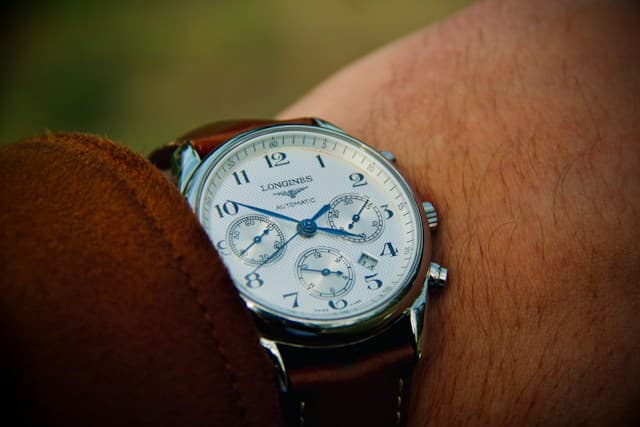
Somewhere in the world, a man is carefully winding a mechanical watch.
He turns the crown between his fingers, feeling the quiet resistance of a spring being tightened inside a tiny metal case.
The watch may have taken months to manufacture. Its movement may contain hundreds of components. It may have cost more than a perfectly respectable second-hand car.
And when he wants to know the exact time, he could simply look at his phone.
So why does he still wear the watch?
It is a question that reveals something fascinating about luxury, technology and the things human beings choose to love.
The Object That Lost Its Purpose
For much of the twentieth century, a wristwatch answered a practical question. What time is it? A glance at the wrist could settle the matter without interrupting a conversation, opening a newspaper or searching for a clock.
Today, the answer is everywhere. It appears on our telephones, computers, kitchen appliances and car dashboards. Time has become one of the most readily available pieces of information in modern life.
And yet we continue to wear watches.
Not merely inexpensive watches that perform a useful task. We buy mechanical watches that cost thousands, sometimes tens of thousands, of pounds, euros or dollars. We admire movements that require servicing. We discuss tiny differences in dial typography. We celebrate objects that may be less accurate than a modest electronic alternative.
Viewed purely as instruments, this behaviour is difficult to explain.
Viewed as human behaviour, it begins to make perfect sense.
The Revolution That Should Have Ended Everything
The mechanical watch did not survive because technology failed to produce a better way of measuring time.
It survived despite technology succeeding.
During the twentieth century, electronic timekeeping transformed the industry. Quartz watches used the regular vibrations of a quartz crystal, controlled electronically, to measure time with remarkable precision.
They could be accurate, affordable and convenient. For many everyday purposes, they offered clear advantages over traditional mechanical movements.
The upheaval of the 1970s and early 1980s became known as the quartz crisis, particularly because of its consequences for established Swiss watchmaking.
An industry built on generations of mechanical expertise suddenly faced competition from products that could do its central job more efficiently.
The remarkable part of the story is not that quartz watches became successful. That was entirely understandable.
The remarkable part is that mechanical watches found a reason to exist after accuracy ceased to be their strongest argument.
Their makers increasingly offered something that could not be measured in seconds gained or lost.
They offered a story.
A Small Machine With a Human Heart
Open the case of a traditional mechanical watch and you enter a miniature world of wheels, springs, bridges, pivots and carefully controlled movement.
Energy stored in a mainspring passes through a system of gears. An escapement regulates its release. The balance oscillates, allowing the hands to advance across the dial.
None of this is magic. It is engineering.
But engineering can be beautiful.
A mechanical watch makes an abstract concept tangible. Time, which we cannot hold or stop, is represented by a machine that can be assembled, adjusted, repaired and understood.
It is tempting to call the movement a living thing. Strictly speaking, it is not. It has no consciousness, intention or feelings. But the metaphor survives because the machine responds to us.
An automatic watch draws energy from the movement of its wearer. A manually wound watch asks for a small ritual of attention. Leave either alone for long enough, and it eventually stops.
There is something appealing about an object that does not pretend to be independent of the person who owns it.
It needs us, just a little.
The Watch as a Biography
Two people can wear the same model of watch for entirely different reasons.
For one, it may represent professional success. For another, it may commemorate a wedding, a graduation or the birth of a child.
A third person may have inherited it from a parent and feel no particular interest in its market value.
The watch itself cannot tell us which story is true.
This is one of the limitations of judging people by their possessions. We see the object, but rarely the meaning attached to it.
A scratched watch can be a source of embarrassment to one owner and a treasured reminder of life to another.
Some collectors prize originality. Others enjoy restoration. Some want a watch that looks untouched. Others want evidence that it has travelled through the world.
Perhaps the most interesting watches are not necessarily the rarest.
They are the ones that have become part of someone's biography.
Of Course, There Is Status
It would be disingenuous to pretend that luxury watches exist outside the world of status.
Certain names, shapes and designs are instantly recognisable to people who know what to look for. An expensive watch can communicate financial success, taste, professional identity or membership of a particular social circle.
Sometimes that message is deliberate. Sometimes it is not.
Luxury watch marketing understands the emotional power of achievement. Advertising often associates timepieces with exploration, sporting excellence, inheritance and extraordinary personal accomplishment.
There is nothing inherently wrong with enjoying an object that represents a milestone.
But the relationship becomes less satisfying when the object must continually persuade other people that its owner matters.
A watch can be expensive without being interesting. It can be fashionable without being beautiful. And it can be admired by strangers while offering very little pleasure to the person wearing it.
The distinction between appreciation and display is subtle, but important.
Are we wearing the watch because we love it?
Or because we love what we hope it says about us?
The Strange Economics of an Obsolete Object
The continued commercial significance of watches reveals how far they have travelled beyond their original purpose.
According to the Federation of the Swiss Watch Industry, Switzerland exported 14.6 million wristwatches in 2025, with a combined export value of 24.4 billion Swiss francs.
Those figures describe exports, not final retail sales, and they do not suggest that every watch was mechanical or luxurious. But they illustrate the scale of an industry that has continued to find customers in an age of ubiquitous digital timekeeping.
A watch may be purchased for its design, its technical ingenuity, its cultural associations or the satisfaction of owning something made with exceptional care.
It may also be purchased as a speculative asset, although future resale values are uncertain and a luxury watch should never be assumed to be a reliable investment.
The extraordinary prices sometimes attached to particular models reflect a mixture of manufacturing, brand power, scarcity, fashion and market demand.
Price alone cannot tell us how much craftsmanship an object contains.
Nor can it tell us how much happiness the owner will derive from it.
The market can establish what someone is willing to pay.
It cannot establish what something ought to mean.
Why We Are Drawn to Things That Last
Modern technology is remarkable partly because it changes so quickly.
A device that once seemed revolutionary can become outdated within a few years. Software evolves, batteries deteriorate and new functions make older products feel limited.
A well-maintained mechanical watch offers a different proposition.
Its basic purpose remains understandable. Its mechanism can often be serviced by a skilled watchmaker. Its design may remain appealing long after the year in which it was made.
This does not mean every mechanical watch will last forever. Parts can wear, repairs can become expensive, and some movements are difficult to maintain.
But the possibility of long-term care is central to the appeal.
There is pleasure in knowing that an object does not necessarily have to be replaced simply because the world has moved on.
A watch may even become more meaningful with age.
The polished case acquires marks. The bracelet softens. The owner remembers where it has been.
The passage of time, which the watch was built to measure, begins to change the watch itself.
That is a rather beautiful contradiction.
Perhaps We Never Wore Them Just to Tell the Time
The disappearance of practical necessity has revealed something that may have been true all along.
Human beings rarely choose possessions for utility alone.
We choose them for beauty, identity, memory, pleasure and the stories we attach to them.
A painting does not need to be useful. A piece of music does not need to solve a problem. A beautiful chair may offer something beyond the ability to sit down.
The mechanical watch occupies an unusual position between art, engineering, jewellery and everyday equipment.
It can be worn, admired, studied and passed on.
It reminds us of time while inviting us to forget, briefly, about efficiency.
And perhaps that is why the mechanical watch remains compelling.
Not because we need another way to know what time it is.
But because we still need ways to give time meaning.
The VILCERIQUE Point of View
A watch tells us what time it is.
The best ones remind us what time means.
Sources & Further Reading
This essay combines historical and technical information with VILCERIQUE's independent editorial interpretation of watch culture.
- Federation of the Swiss Watch Industry ↗
Official Swiss watch export statistics and annual industry reporting.
- The National WWII Museum ↗
Historical context on the watch industry and the quartz revolution.
- USC Viterbi School of Engineering ↗
The cultural and engineering significance of mechanical watches.