The VILCERIQUE Journal / Essay No. 011
The Beautiful
Imperfection
On Japanese pottery, handmade objects, and the curious possibility that perfection is not always beautiful.
October 26, 2026·Heritage / Culture / Watches
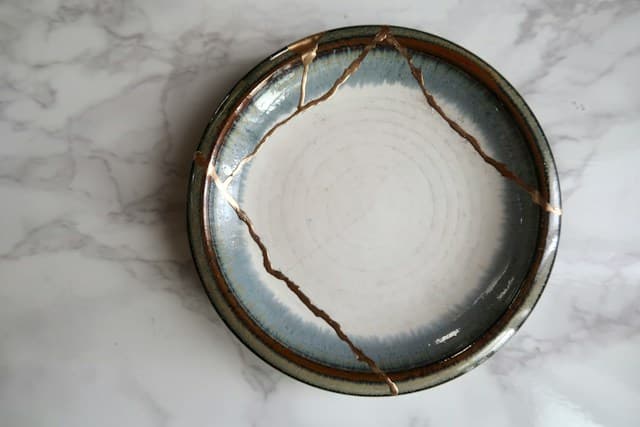
A Crack in the Bowl
Imagine a ceramic bowl.
It is old.
Its surface is uneven, its glaze slightly irregular. The rim is not perfectly symmetrical.
And running across one side is a crack.
Someone has repaired it.
But instead of attempting to conceal the damage, the repair makes it visible.
A fine line of gold follows the fracture.
The bowl is no longer what it was when it left the potter's hands.
It has been broken.
Repaired.
Changed.
And yet there is something extraordinarily beautiful about it.
Perhaps more beautiful than before.
The Japanese art of kintsugi, in which broken ceramics are repaired using lacquer and, in some forms, powdered precious metal, has become a powerful metaphor for the acceptance of imperfection.
The repair does not necessarily pretend that the object was never damaged.
It allows the history of the object to remain visible.
And in doing so, it challenges an assumption that governs much of modern life.
That the most beautiful thing must also be the most perfect.
The Tyranny of the Flawless
We live in an age of remarkable precision.
Machines can manufacture components to tolerances almost impossible to imagine.
Digital photographs can be corrected until every blemish disappears.
Furniture can be produced in enormous quantities with virtually identical dimensions.
Watches can be regulated to astonishing levels of accuracy.
Even our faces can be altered on a screen until they resemble idealised versions of ourselves.
There is much to admire in this.
Precision has transformed medicine, engineering, transportation and countless other fields.
A surgeon should not celebrate an imprecise instrument.
An aircraft manufacturer should not regard a faulty component as charming.
Perfection, or the pursuit of it, can be essential.
But the problem begins when we assume that the same standard should govern everything.
A handmade ceramic cup is not an aircraft component.
A leather bag is not a surgical instrument.
And a human face is not a technical drawing.
There are things whose value depends on accuracy.
And there are things whose beauty depends on character.
Confusing the two can leave us surrounded by flawless objects that somehow fail to move us.
The Hand of the Maker
Consider two wooden chairs.
The first is manufactured in a modern factory.
Its dimensions are exact.
Its finish is consistent.
Every example looks essentially the same.
The second is made by a skilled craftsperson.
Its proportions are carefully considered, its joints precisely fitted, its surface patiently finished.
But look closely and you may discover subtle variations.
The grain of the wood follows its own path.
A tool has left a barely perceptible mark.
One curve is not mathematically identical to another.
These details are not necessarily defects.
They may be evidence of the process through which the object came into existence.
Of course, not every irregularity is beautiful.
Poor craftsmanship does not become admirable simply because it is handmade.
A badly constructed chair remains a badly constructed chair.
The distinction matters.
True craftsmanship is not the absence of discipline.
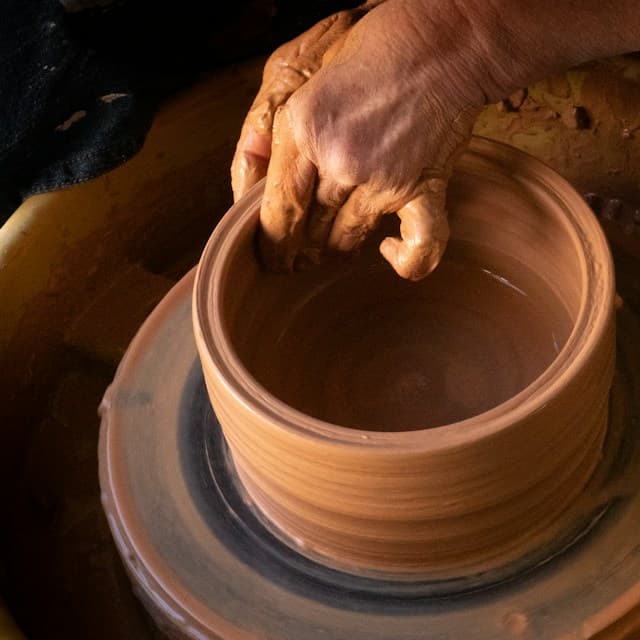
It is discipline exercised by a human being working with materials that possess their own characteristics.
The maker does not always impose complete uniformity.
Sometimes the maker responds to what the material allows.
A knot in the wood.
A variation in the leather.
A particular piece of stone.
The finished object becomes the result of a conversation between intention and material.
And that conversation can produce something a machine-made copy struggles to reproduce.
Not necessarily greater technical perfection.
But a sense of individuality.
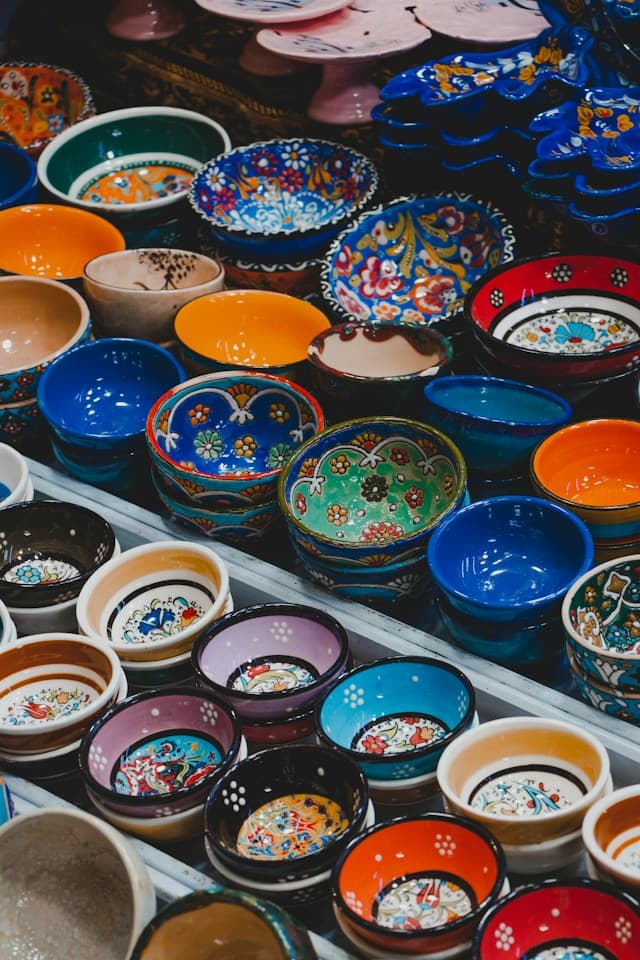
What the Japanese Understood
The Japanese aesthetic concept of wabi-sabi is often described in Western writing as an appreciation of imperfection, impermanence and incompleteness.
That description is useful, although it simplifies a much richer and historically complex set of ideas.
Its associations include modesty, natural materials, the passage of time and forms of beauty that do not depend on splendour.
A weathered wooden surface.
A simple tea bowl.
A quiet room.
An object that reveals its age rather than concealing it.
There is a kind of restraint in this sensibility.
Beauty does not need to demand attention.
It may emerge through familiarity.
Through observation.
Through the willingness to notice something small.
Kintsugi and wabi-sabi are not identical traditions, and neither should be reduced to a fashionable slogan about broken things being better.
Yet they can invite a similar question.
What if the signs of time and use are not always evidence that an object has lost value?
What if they sometimes contribute to its beauty?
That is a challenging idea in a culture where newness is so frequently treated as a virtue.
The Luxury Industry's Contradiction
Luxury brands speak constantly about craftsmanship.
The hand of the artisan.
The exceptional material.
The traditions preserved across generations.
The time required to make something properly.
And often, these claims reflect genuine expertise.
A finely made watch movement can require extraordinary knowledge.
A hand-stitched leather object can involve years of accumulated skill.
A piece of haute couture may represent hundreds of hours of painstaking work.
But the industry also sells an ideal of immaculate perfection.
Perfect surfaces.
Perfect stitching.
Perfect symmetry.
Perfect presentation.
Objects are photographed under controlled lighting.
Every reflection is considered.
Every visible detail is polished.
The product arrives in packaging designed to make the moment of ownership feel almost ceremonial.
There is nothing inherently wrong with this.
When people pay substantial sums, they are entitled to expect excellent quality.
But a curious tension emerges.
Luxury celebrates the human hand while often attempting to remove every visible trace of human variation.
The maker is praised.
The evidence of making is sometimes concealed.
And the customer is encouraged to admire craftsmanship while expecting the object to resemble something untouched by human life.
Perhaps this is why certain older objects can feel so compelling.
They no longer appear to be trying to prove their perfection.
They simply exist.
With all the evidence of having been made, used and kept.
The Watch That Was Never Quite Perfect
Mechanical watches provide a particularly interesting example.
A mechanical watch is an extraordinary miniature machine.
Its gears, springs and regulating components work together to measure the passage of time.
The finest examples represent generations of technical development.
But even an excellent mechanical watch may gain or lose a small amount of time.
A comparatively inexpensive quartz watch can often keep more accurate time.
A smartphone, synchronised with modern timekeeping systems, is more convenient still.
So why do people continue to admire mechanical watches?
Certainly, part of the attraction is craftsmanship.
Part is design.
Part is heritage.
And part may be the pleasure of owning something whose operation is visible, understandable and fundamentally physical.
A mechanical watch does not merely display the time.
It performs a process.
Its balance oscillates.
Its gears turn.
Its spring releases stored energy.
The movement is not alive, of course.
But it possesses a rhythm that can make it feel strangely companionable.
The slight limitations of mechanical timekeeping are not necessarily the reason people love these watches.
Yet they remind us that the object belongs to a different world from the frictionless precision of digital technology.
A world of springs, wheels, lubrication, adjustment and maintenance.
A world in which the passage of time is measured by something that must itself be cared for.
The appeal is not that the watch is inaccurate.
It is that accuracy is not the only thing it offers.
When Damage Becomes History
There is an important difference between a beautiful irregularity and damage.
A crack in a ceramic bowl may compromise its usefulness.
A damaged watch movement may need immediate repair.
A weakened leather strap may no longer be safe.
Romanticising deterioration can become foolish when it ignores function.
And yet some signs of age tell a story without destroying the object.
The softened leather of a favourite bag.
The gentle wear on a wooden desk.
The small scratches on a watch worn for decades.
The fading of a well-loved book cover.
These marks may have little aesthetic value to a stranger.
But to the owner, they can become inseparable from the object's identity.
The desk is not merely a desk.
It is where letters were written.
The watch is not merely a watch.
It was worn on important days.
The bag is not merely a bag.
It has travelled.
Its surface contains evidence of a life.
And perhaps that is why replacing an old possession with an identical new one does not always feel like an improvement.
The new object may be technically superior.
But it lacks the history.
You can reproduce the design.
You cannot reproduce the years.
The Problem With Our Faces
The pursuit of perfection does not stop with objects.
It extends to the people who own them.
We are surrounded by images of idealised bodies, faces and lifestyles.
Skin is smoothed.
Features are adjusted.
Signs of age are concealed.
Even photographs presented as spontaneous may have been carefully selected, edited and arranged.
The result is a strange contradiction.
We admire the character of an old building.
We celebrate the patina of vintage leather.
We describe a weathered landscape as beautiful.
But when the passage of time becomes visible on a human face, we are often encouraged to regard it as a problem.
Something to correct.
Something to delay.
Something to purchase a solution for.
There is nothing wrong with wanting to look good.
Nor is there anything inherently wrong with cosmetics, skincare or aesthetic treatments.
Personal appearance is a matter of individual choice.
But it is worth asking whether the ideal of flawless beauty has become unnecessarily narrow.
A face can be beautiful because of its expression.
Its warmth.
Its humour.
Its history.
Its individuality.
These qualities are difficult to measure.
And impossible to standardise.
Perhaps the most compelling human faces are not always the ones that come closest to an abstract ideal.
Perhaps they are the ones that look unmistakably like themselves.
The Value of Something Unique
Modern manufacturing has given us extraordinary abundance.
It has also made uniformity familiar.
We can purchase identical objects in cities thousands of miles apart.
The same furniture.
The same clothing.
The same accessories.
The same carefully controlled aesthetic.
There is comfort in consistency.
But there can also be a quiet pleasure in owning something that does not exist in precisely the same form anywhere else.
A handmade bowl.
A piece of vintage furniture.
A watch with a particular history.
A painting.
An inherited object.
Something that carries a trace of its maker or its previous life.
Its uniqueness does not automatically make it valuable.
But it may make it more difficult to replace.
And perhaps replaceability is one of the hidden problems of modern consumption.
When everything can be exchanged for an identical new version, we may become less inclined to form lasting attachments.
We begin to think of objects primarily in terms of their condition.
Their specifications.
Their resale value.
Their ability to remain fashionable.
Instead of asking whether they have become part of our lives.
An imperfect object can sometimes resist this logic.
Its particular marks belong to it alone.
To replace it would not simply mean obtaining another example.
It would mean losing something specific.
The Courage to Leave Something Alone
There is a quiet confidence in accepting that not everything needs improvement.
A wooden table does not always need refinishing.
A leather bag does not always need replacing.
A watch does not always need polishing.
A face does not always need correcting.
Sometimes care means restoration.
Sometimes it means repair.
And sometimes it means knowing when to leave something alone.
This is not an argument against progress.
Nor is it a celebration of poor quality.
It is an argument for discrimination.
For recognising that different things require different standards.
A broken mechanism should be repaired.
A dangerous defect should be corrected.
But a harmless mark of age may deserve to remain.
Not because imperfection is automatically beautiful.
But because beauty is not always found in the absence of imperfection.
Sometimes it is found in the relationship between the object and its history.
Between the maker and the material.
Between the owner and the years.
Return, for a moment, to the ceramic bowl.
The crack remains visible.
The gold follows its path.
The bowl is not pretending to be new.
And perhaps that is what makes it so compelling.
It has survived something.
Someone considered it worth repairing.
And rather than erasing that decision, the repair allows us to see it.
The beauty is not simply in the broken ceramic.
Nor in the gold.
The VILCERIQUE Point of View
Perfection can be an extraordinary achievement.
But it is not the only form of beauty.
Sometimes the most remarkable thing about an object is not that it has remained untouched.
It is that someone cared enough to keep it.
Sources & Further Reading
This essay combines historical and cultural perspectives on Japanese aesthetics, craftsmanship and mechanical watchmaking with independent editorial reflection on beauty, ageing and imperfection.
- The Metropolitan Museum of Art — Japanese Art ↗
Historical and cultural context for Japanese ceramics, craftsmanship and artistic traditions.
- Victoria and Albert Museum — Japan ↗
Japanese art, design and material culture in the museum's collections.
- The Japan Society ↗
Cultural background and perspectives on Japanese traditions and aesthetics.
- Leonard Koren — Wabi-Sabi for Artists, Designers, Poets & Philosophers ↗
An influential introduction to wabi-sabi for Western readers.
- Richard Sennett — The Craftsman ↗
A study of craftsmanship, skill and the relationship between people and the things they make.
- British Horological Institute ↗
Background on traditional watchmaking and mechanical horology.