The VILCERIQUE Journal / Essay No. 008
The Lost Art
of Repairing Things
On watchmakers, worn leather, disappearing skills, and the quiet dignity of making something last.
October 26, 2026·Heritage / Watches / Culture
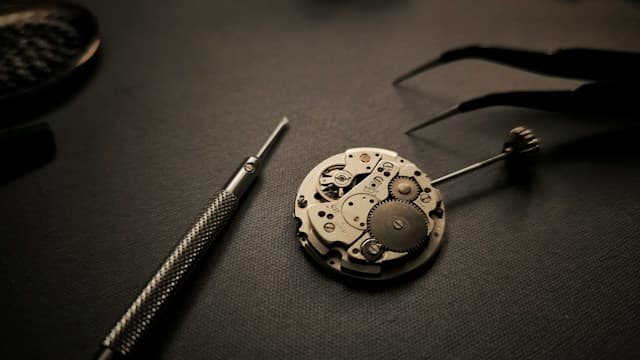
Somewhere, in a workshop most people will never visit, an old watch is ticking again.
It may have been silent for twenty years.
Perhaps it belonged to someone's father. Perhaps it spent decades in a drawer, wrapped in a handkerchief, waiting for a decision nobody quite knew how to make.
Its owner might have been told that repairing it would cost more than buying a new watch.
A perfectly reasonable observation.
And yet, here it is.
A watchmaker sits beneath a bright lamp, surrounded by instruments so small and specialised that they seem to belong to another century.
He has taken the movement apart, cleaned its components, examined the worn surfaces and replaced what could no longer function.
Now he watches the balance wheel oscillate.
A tiny mechanical heartbeat.
The watch tells time again.
But something more interesting has happened.
An object that had effectively disappeared from someone's daily life has returned.
Not as a replacement.
As itself.
And that distinction is becoming increasingly rare.
A Different Understanding of Value
There was a time when repairing something was simply part of owning it.
Shoes were resoled.
Furniture was reupholstered.
Clothes were altered.
Watches were serviced.
A broken radio might be taken to someone who understood radios.
This was not necessarily evidence of a more virtuous society.
Many people repaired things because replacing them was expensive, difficult or impossible.
Households often had fewer possessions, and those possessions represented a greater share of their income.
Repair was an economic necessity.
But necessity created something valuable.
Knowledge.
People understood how objects were constructed. They knew which parts were likely to fail. They learned what could be fixed and what could not.
And entire professions developed around keeping things in service.
The shoemaker did not merely sell shoes.
The watchmaker did not merely sell watches.
They maintained a relationship between an object and its owner.
Today, we often describe a product as valuable by referring to its price.
But price is only one way to measure value.
There is also the value of usefulness.
The value of craftsmanship.
The value of familiarity.
And sometimes, the value of knowing that something has been with us long enough to become part of our story.
A repair can preserve all of those things.
A replacement cannot always do the same.
The Watchmaker's Paradox
Mechanical watches offer a particularly fascinating example.
A modern quartz watch can be extraordinarily accurate, inexpensive and reliable.
A smartphone can tell the time with greater convenience than almost any traditional wristwatch.
Yet people continue to spend substantial sums on mechanical timepieces.
Why?
Partly because a mechanical watch represents something that modern technology has made unnecessary.
Hundreds of tiny components working together to measure the passage of time.
Springs.
Wheels.
Jewels.
Levers.
An escapement releasing energy in carefully controlled increments.
The mechanism is ingenious, but its attraction is not simply technical.
It is emotional.
A mechanical watch makes time visible as a physical process.
And, crucially, many mechanical watches are designed with servicing in mind.
They can be opened.
Inspected.
Disassembled.
Cleaned.
Adjusted.
Reassembled.
This does not mean every mechanical watch can be repaired indefinitely. Components wear out, parts may become unavailable, and some repairs are economically or technically impractical.
But the underlying philosophy is important.
The object was not necessarily intended to become useless when one component failed.
It was constructed around the possibility of maintenance.
There is a paradox here.
The watch may be less convenient than the technology that replaced its original function.
Yet it may offer something the newer technology often struggles to provide.
Continuity.
A well-maintained mechanical watch can accompany more than one generation.
Not because it is immune to time.
But because someone can intervene when time begins to take its toll.
The Beauty of a Second Sole
Consider a good pair of leather shoes.
After several years, the soles may be worn almost through.
The uppers, however, might still be beautiful.
The leather has softened.
The creases have settled into familiar places.
The shoes have gradually adapted to the feet of the person who wears them.
A disposable approach sees a worn sole and concludes that the shoes are finished.
A skilled cobbler sees a different problem.
The upper is sound.
The construction permits repair.
The sole can be replaced.
Of course, not every shoe is made this way. Some constructions are difficult or uneconomical to repair, and the quality of materials varies enormously.
But repairable footwear demonstrates a simple principle.
A product does not have to fail as a whole merely because one part has worn out.
This idea extends far beyond shoes.
A jacket can receive a new lining.
A chair can be reupholstered.
A handbag can have its stitching repaired.
A wooden table can be refinished.
In each case, the object remains recognisably itself.
Its history is not erased.
Its usefulness is restored.
And perhaps that is what makes a successful repair so satisfying.
It offers the pleasure of renewal without requiring the destruction of continuity.
The Skills We Cannot Simply Download
A remarkable amount of human knowledge exists outside books.
It lives in hands.
In habits.
In the ability to recognise a problem by its sound, its resistance or the way a material responds to pressure.
An experienced craftsperson may notice things that are difficult to describe.
A watchmaker hears an irregularity.
A tailor sees how a garment falls.
A furniture restorer recognises the difference between surface damage and structural failure.
Some of this knowledge can be taught through manuals, videos and formal training.
But much of it develops through repeated practice.
Years of mistakes.
Years of observation.
Years of learning which solutions work and which merely appear to.
This is sometimes called tacit knowledge: understanding that is difficult to communicate completely through words or instructions.
It is one reason why craftsmanship cannot always be reproduced simply by acquiring the correct tools.
A workshop full of expensive equipment does not automatically produce a skilled craftsperson.
The tools matter.
The person matters more.
And when a specialised workshop closes without someone learning its methods, part of that knowledge may disappear.
Not every traditional skill is vanishing, of course. Some crafts are enjoying renewed interest, and modern training, online communities and specialist schools can help preserve them.
But preserving a skill requires more than admiring it.
Someone must be willing to learn.
Someone must be willing to teach.
And enough people must be willing to pay for the work to make the profession sustainable.
That last requirement is often the most difficult.
Why Repair Can Seem So Expensive
Imagine taking an inexpensive appliance to a technician.
The technician must inspect it, identify the fault, locate a replacement component, perform the repair and test the result.
The process takes time.
The technician needs a workplace, tools, training and an income.
By the time the work is complete, the bill may approach the price of a new appliance.
The customer faces an understandable choice.
Why repair the old one when a new one costs almost the same?
This is not necessarily evidence that the technician is charging too much.
It may simply reveal the strange economics of modern manufacturing.
Factories can produce enormous quantities of identical objects with highly optimised processes.
A repairer, by contrast, often works on one individual object at a time.
Mass production benefits from scale.
Repair depends on attention.
And attention is expensive.
The difficulty becomes greater when manufacturers use components that are hard to replace, limit access to spare parts or construct products in ways that make disassembly difficult.
But the situation is not universal.
Some manufacturers actively support repair through spare parts, service networks and product designs intended for maintenance.
And public policy is beginning to pay greater attention to the issue.
The European Union has adopted legislation intended to make repair easier for certain categories of products, alongside broader measures addressing product durability and consumer information.
These changes will not make every repair affordable.
But they reflect a growing recognition that the ability to repair something has value beyond the individual transaction.
A repairable product offers its owner a choice.
An unrepairable product removes one.
When Luxury Remembers What It Is For
The luxury industry has an interesting relationship with repair.
At its best, luxury has always been closely connected to durability, craftsmanship and specialist knowledge.
A fine watch can be serviced.
A quality leather bag can often be restored.
A well-made garment can be altered.
A piece of jewellery can be repaired or resized.
Some established luxury houses maintain workshops and after-sales services precisely because their products are expected to remain in use for many years.
That is one of the strongest arguments in favour of buying fewer, better things.
But there is also a contradiction.
Luxury companies depend on selling new products.
New collections.
New colours.
New designs.
New reasons to desire something.
The same industry that celebrates timeless craftsmanship also participates in a culture of perpetual novelty.
A brand may proudly explain how an object can last for decades while simultaneously encouraging customers to replace it with the latest version.
This tension is not unique to luxury.
But it is particularly visible there because longevity is so often part of the promise.
If a company claims that its products are made to last, repair should not be an inconvenient afterthought.
It should be part of the relationship.
A product that can be maintained for thirty years tells a different story from one that is merely expensive on the day it is purchased.
One asks to be admired.
The other asks to be kept.
The Repair That Makes Something More Valuable
Not every repair should be invisible.
In Japanese ceramics, kintsugi refers to techniques in which broken pottery is repaired using lacquer, often with powdered precious metal highlighting the joins.
The repaired object does not pretend that the damage never happened.
The break becomes part of its visible history.
The technique has acquired an enormous symbolic life outside its original craft traditions.
It is frequently used as a metaphor for resilience, healing and the acceptance of imperfection.
Sometimes the metaphor is stretched beyond recognition.
But the underlying aesthetic idea remains compelling.
Damage does not always eliminate beauty.
And repair does not always need to conceal the fact that something has been repaired.
A carefully darned sweater can be beautiful.
A visible patch on a favourite jacket can be charming.
An old wooden chair may retain evidence of previous restorations.
These marks tell us that someone considered the object worth saving.
Of course, not every damaged object becomes more attractive.
Some repairs are clumsy.
Some materials deteriorate beyond recovery.
And sometimes replacing something is the more sensible decision.
The point is not that every scratch deserves reverence.
It is that imperfection should not automatically be mistaken for worthlessness.
There is a difference between an object that has been used and one that has been used up.
What We Lose When Nobody Can Fix It
Imagine a town in which the last independent watchmaker closes.
At first, very little appears to change.
People still have watches.
They can buy new ones online.
They can send expensive pieces to distant service centres.
But something local has disappeared.
A person who could diagnose a problem.
A person who knew the history of particular mechanisms.
A person who might have repaired a grandfather's watch, then his son's, then his granddaughter's.
The loss is not merely commercial.
It is cultural.
A specialised workshop is a small repository of accumulated human experience.
Its disappearance changes what a community can do for itself.
And when enough of these places disappear, the relationship between people and possessions changes too.
Objects become more mysterious.
Not because they are more sophisticated.
But because fewer people understand what is inside them.
We become increasingly dependent on systems that can replace products efficiently but may not always help us understand or maintain them.
That dependence is not necessarily disastrous.
Modern manufacturing has made countless useful things more affordable and accessible.
But it is worth recognising what can be lost alongside those benefits.
Convenience is valuable.
So is competence.
And a society that becomes exceptionally good at buying things may still have reason to preserve the people who know how to keep them working.
The Quiet Dignity of Making Something Last
Perhaps the most beautiful thing about repair is that it requires a particular attitude towards the world.
Before something can be repaired, someone must decide that it is worth the effort.
Worth examining.
Worth understanding.
Worth spending time on.
That decision is not always financially rational.
An old watch may cost more to restore than its resale value.
A chair may require hours of work when a new one could be delivered tomorrow.
A favourite coat may need a new lining even though its style has long since disappeared from shop windows.
But people make these decisions anyway.
Because objects are not always interchangeable.
The watch was a gift.
The chair belonged to a grandmother.
The coat has travelled through twenty winters.
A replacement may perform the same function.
It may even perform it better.
But it cannot inherit the past.
Repair is one way of acknowledging that distinction.
It says that the years an object has already spent with us are not necessarily a reason to discard it.
They may be the reason to keep it.
And somewhere, in a quiet workshop, a watchmaker is listening to a mechanism that has just begun to tick again.
It is an ordinary sound.
Almost insignificant.
Yet it contains something our culture could perhaps use a little more of.
The belief that what already exists may still be worth saving.
The VILCERIQUE Point of View
The true luxury of a well-made object is not that it never breaks.
It is that, when it does, someone still knows how to bring it back.
Craftsmanship does not end when something is sold.
Sometimes, that is where it begins.
Sources & Further Reading
This essay combines research on craftsmanship, product repair, conservation and European sustainability policy with VILCERIQUE's independent editorial interpretation.
- European Commission — Right to Repair ↗
European legislation and policy aimed at making the repair of certain consumer products easier and more accessible.
- European Commission — Ecodesign for Sustainable Products ↗
The EU framework for improving product sustainability, durability and repairability.
- UNESCO — Intangible Cultural Heritage ↗
Background on safeguarding and transmitting traditional craftsmanship and cultural knowledge.
- Richard Sennett — The Craftsman ↗
A study of craftsmanship, skill, practice and the value of doing work well.
- Michael Polanyi — The Tacit Dimension ↗
The philosophical account of knowledge that cannot always be fully expressed through explicit instructions.
- Victoria and Albert Museum ↗
Museum research and conservation material relating to historic objects, craftsmanship and restoration.